Have you ever bought a dehumidifier, plugged it in, and noticed your room still smells like a wet dog? It’s frustrating.
You spend good money to fix a moisture problem, but if you pick the wrong size, you create new issues. If you undersize the unit, it runs constantly until the motor burns out, and you still end up with mold. Oversize it, and the machine short-cycles—turning on and off so fast it never actually pulls moisture out of the air. This wastes your electricity and leaves your space damp.
We’ve seen these exact moisture headaches ruin inventory and damage workspaces. Today, we’ll show you exactly how to calculate the right dehumidifier size for your specific needs, so you can keep your air dry and your equipment running efficiently.
Sizing is About Capacity, Not Physical Dimensions
Let’s clear up the biggest misconception right away. Dehumidifier sizing has nothing to do with the physical size of the plastic box.
Proper sizing is strictly a calculation of moisture removal capacity relative to the volume of your space. It also heavily depends on the severity of the humidity load you are fighting.
Understanding Capacity Ratings: DOE vs. AHAM
Before you start doing math, you need to understand how manufacturers test their machines. If you compare a residential unit to an industrial one, you’re looking at completely different rating scales.
The DOE Standard (Residential)
The Department of Energy (DOE) tests consumer units at 65°F and 60% Relative Humidity (RH). This mimics a realistic, cool basement. A unit pulling 50 pints under these DOE standards is actually a very capable machine.
The AHAM Standard (Commercial)
The Association of Home Appliance Manufacturers tests industrial equipment at 80°F and 60% RH. Warmer air holds significantly more water. Because of this, AHAM ratings always look much higher on paper.
Beware the Saturation Rating
Marketing materials love to push the “saturation rating,” which tests the unit at a sweltering 90°F and 90% RH. You should generally ignore this. Unless you live in a sauna, a unit rated for 70 pints at saturation might only pull 25 pints in your 60°F basement.
Standard Sizing for Homes and Light Commercial Spaces
If you’re dealing with standard rooms or offices with typical 8-foot ceilings, you can size your unit using square footage and your current dampness level.
Step 1: Honest Dampness Assessment
You have to be realistic about your moisture load. If you underestimate here, your dehumidifier will fail to keep up.
Condition | Humidity | What it looks and feels like |
Moderately Damp | 50–60% RH | Clammy air and a musty smell in humid weather. |
Very Damp | 60–70% RH | Persistent odors and visible damp spots on walls. |
Wet | 70–80% RH | Visible mold, seepage, and floors that feel wet. |
Extremely Wet | 80–100% RH | Standing water, active leaks, or indoor laundry drying. |
Step 2: The Square Footage Sizing Chart
Room Area (Sq. Ft.) | Moderately Damp | Very Damp | Wet | Extremely Wet |
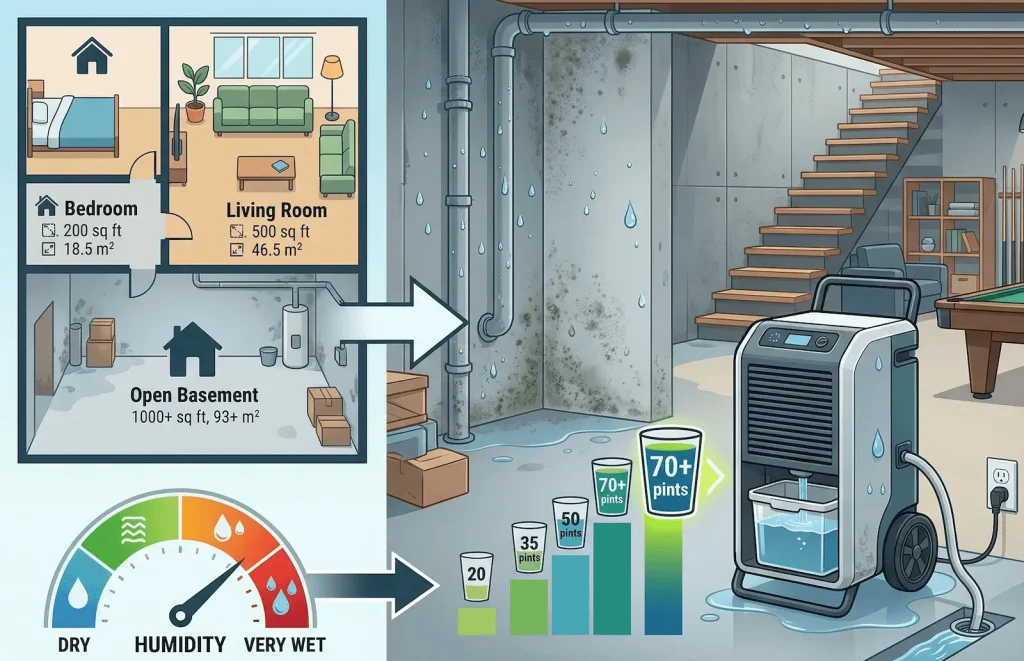
500 | 20 Pints | 30 Pints | 35 Pints | 50 Pints |
1,000 | 30 Pints | 40 Pints | 50 Pints | 50+ Pints |
1,500 | 35 Pints | 45 Pints | 50 Pints | 60+ Pints |
2,000 | 45 Pints | 50 Pints | 60+ Pints | 100 Pints |
Once you know your condition, use this chart to find your minimum capacity in Pints Per Day (PPD). These numbers are based on the stricter DOE 65°F standard.If your ceilings are higher than 10 feet, throw out the square footage method. You’ll need to calculate cubic footage instead and bump up your capacity requirement by about 30%.
Advanced Sizing for Water Damage Restoration
If you’re a professional tackling a flood, standard square footage charts won’t help you. You need to follow the official IICRC S500 standards to dry out the space safely and quickly.
Calculating the Requirement
First, find your cubic footage by multiplying Length × Width × Height. Next, determine your Class of water intrusion.
- Class 1: Very little water, slow evaporation.
- Class 2: Moderate water, significant evaporation.
- Class 3: Heavy water, overhead impact, fast evaporation.
Divide your total cubic footage by the specific factor below to find your required AHAM pints per day.
Dehumidifier Type | Class 1 Factor | Class 2 Factor | Class 3 Factor |
Conventional | 100 | 40 | 30 |
LGR | 100 | 50 | 40 |
For example, if you have a 4,000 cubic foot room with Class 2 damage using an LGR unit, divide 4,000 by 50. You’d need exactly 80 pints of AHAM capacity to do the job.
Sizing for Cold Basements and Crawl Spaces
Below-grade spaces are tricky because standard refrigerant dehumidifiers lose efficiency when temperatures drop below 65°F. The coils can freeze up, leaving you with high electricity bills and zero moisture removal.
If your basement hovers around 60°F or lower, you might want to upsize your capacity by 30%. Alternatively, an LGR (Low Grain Refrigerant) unit could be a better fit since they operate effectively down to 34°F.
For crawl spaces, always calculate the total volume. If the space is encapsulated, treat it as moderately damp. If it has open vents, treat it as extremely wet because you are essentially trying to dehumidify the outside air. We always recommend exploring comprehensive moisture control solutions to seal those vents first.
Installation Factors That Make or Break Performance
A perfectly sized unit will still fail if you ignore airflow and drainage logistics. Capacity removes the water, but CFM (Cubic Feet per Minute) moves the dry air around the room.
If you put a high-capacity unit with a weak fan in a large open space, you just get a tiny circle of dry air. The corners of the room will stay completely damp. Make sure your unit pushes enough air to create 3 to 5 air changes per hour (ACH).
Finally, think about drainage. A 70-pint unit pulls about 9 gallons of water daily. If you rely on an internal bucket, the machine shuts off the minute it’s full. We highly recommend using a gravity drain hose or a built-in condensate pump so your machine can run uninterrupted.
Quick Summary Checklist
Here is a quick recap to ensure you get your sizing right the first time:
- Use cubic feet instead of square feet for high ceilings or crawl spaces.
- Check your room temperature and buy an LGR unit if it consistently drops below 65°F.
- Compare apples to apples using DOE ratings for homes and AHAM ratings for commercial jobs.
- Ensure the fan is strong enough (CFM) to push dry air to the far corners of the room.
- Always plan for the worst-case scenario. A large variable-speed unit can run slower, but a small unit can’t magically gain capacity.