It’s incredibly frustrating to invest in a new dehumidifier, only to find your facility is still damp a week later.
If you put a standard home unit in a large warehouse, you’re likely throwing money away. Just a few weeks of inadequate humidity control can lead to rusted machinery, ruined cardboard packaging, and thousands of dollars in mold remediation.
Choosing the right system isn’t just about “pints per day.”
In today’s guide, we’ll break down the core engineering differences between commercial and residential dehumidifiers. By the end of this post, you’ll know exactly how to size the right equipment, calculate true operational costs, and protect your assets the right way.
Let’s dive in.
Core Engineering Differences
The main difference between these units is their intended duty cycle. Residential dehumidifiers are basic appliances built for intermittent comfort. Commercial dehumidifiers are heavy-duty industrial tools.
Engineers design commercial units for asset protection, structural drying, and non-stop process control. Here is why the two types perform so differently.
1. Build Quality and Housing Materials
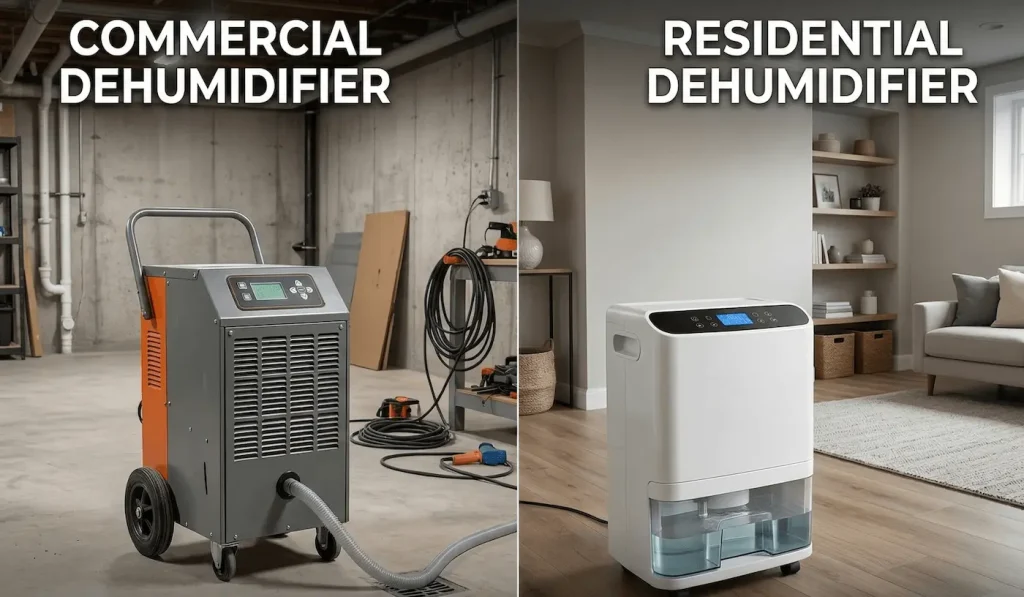
Residential units use lightweight plastic casings. These look nice in a finished home, but they aren’t durable. Manufacturers often secure the internal components with plastic clips. Over time, vibration loosens these clips, leading to rattling noises and eventual failure.
Commercial units prioritize extreme resilience. They feature rotomolded polyethylene or steel housings. This means they can withstand forklift impacts, stacking, and harsh industrial environments without cracking.
They also feature heavy-duty internal mounting. The compressors and coils are bolted directly to steel frames to dampen vibration during 24/7 operation. Furthermore, they are fully serviceable. Technicians can easily open them to replace specific parts, rather than throwing the whole unit away.
2. Airflow and Static Pressure
There is a massive difference in how these units move air. Residential units typically output 100–200 CFM (Cubic Feet per Minute). They rely on passive air circulation. They treat the air right next to the unit, but they lack the fan power to push dry air across a large open floor plan.
Commercial blowers generate 200–400+ CFM and produce significantly higher static pressure. This power allows them to project dry air across massive warehouses. You can also duct them directly into your HVAC systems.
This high airflow is critical. You need it to “scour” moisture out of porous materials like drywall or [Internal Link: link to your guide on protecting cardboard inventory on desiccantglobal.com], rather than just treating the surface air.
3. Compressor Technology and Temperature Range
Standard residential units use basic rotary compressors. These lose efficiency very quickly as the room gets colder. If the temperature drops below 60°F (15°C), the coils freeze. The unit then stops dehumidifying to run a defrost cycle.
Commercial units often use advanced LGR (Low Grain Refrigerant) technology or hot-gas bypass systems.
Because of this tech, commercial units keep removing moisture effectively in temperatures as low as 33°F (1°C). LGR compressors also pre-cool the intake air. This makes them highly efficient, allowing the unit to remove much more water per kilowatt-hour of electricity used.
4. Humidity Control Precision
If you’re drying out a home basement, a ±10% relative humidity (RH) fluctuation is perfectly fine. But if you manage a pharmaceutical lab, an archive, or a food processing plant, that fluctuation could ruin your product.
Residential units use basic mechanical or digital humidistats. These have broad deadbands, meaning the humidity swings wildly before the machine kicks on.
Commercial models use precision sensors. These maintain your exact setpoints within ±1–2%. You can also wire many commercial units into Building Management Systems (BMS) for remote monitoring.
Detailed Comparison: Residential vs. Commercial
We’ve put together a quick technical breakdown to help guide your B2B purchasing decisions.
Feature | Residential Dehumidifiers | Commercial Dehumidifiers |
Primary Application | Comfort (Bedrooms, small basements) | Asset Protection (Warehouses, Factories) |
Daily Capacity | 20–50 Pints | 70–280+ Pints |
Airflow Volume | 100–180 CFM | 200–1000+ CFM |
Duty Cycle | Intermittent (8–12 hours/day) | Continuous (24/7) |
Operating Temp | 60°F – 90°F | 33°F – 100°F+ |
Drainage | Bucket or Gravity Hose | Internal Condensate Pump (High Lift) |
Typical Lifespan | 3–5 Years | 10+ Years |
Application Scenarios
Understanding where each unit excels helps you prevent costly equipment failures. It also ensures you actually solve your moisture problem.
When to Choose Residential
You should only use residential models for small, finished spaces. Choose them when low noise and aesthetics matter more than raw drying power.
- Small Offices & Bathrooms: Spaces under 500 sq. ft. where people generate the moisture, not industrial processes.
- Finished Basements: Minor dampness control in finished living areas.
When to Choose Commercial
If failing to control humidity means damaged inventory or production downtime, a commercial unit is mandatory.
- Warehouses & Storage: Protecting electronics or textiles requires high-CFM airflow to stop mold from growing in microclimates.
- Manufacturing & Industrial: Facilities that require strict dew point control for adhesives or printing.
- Unheated Spaces: Garages and storage units where temperatures drop below 60°F require commercial defrost features.
Cost Analysis: Upfront vs. Operational
A common mistake business owners make is looking only at the initial purchase price.
Residential options have a lower entry price ($200–$400). However, they cost more to operate because of poor energy efficiency. You will also have to replace them every 3–5 years under heavy use.
Commercial options require a higher capital expenditure ($1,000–$3,000+). But, engineers design them to last a decade or more. Because they are serviceable, a cheap $50 part replacement often saves you from buying a whole new unit. Their superior energy efficiency also drastically lowers your monthly electrical bill.
Buying Advice: How to Size Your Solution
You can’t size a dehumidifier just by looking at the square footage of your floor. You have to calculate the specific moisture load.
Step 1: Calculate Cubic Footage
Multiply the Length × Width × Height of your room. Commercial spaces often have high ceilings, which makes standard square footage calculations wildly inaccurate.
- Example: A 2,000 sq. ft. warehouse with 20 ft. ceilings equals 40,000 cubic feet of air.
Step 2: Assess Condition Severity
Next, figure out how bad the moisture problem actually is. You need to classify your space:
- Moderate (50-60% RH): Air conditioning is present, but the space feels damp.
- Significant (70-80% RH): You see visible condensation on pipes; you smell musty odors.
- Extreme (90-100% RH): You have standing water or need active drying.
Step 3: Determine Required Capacity
For a standard commercial space with moderate dampness, you need about 4–5 air changes per hour (ACH).
A 50-pint residential unit might handle 2,000 sq. ft. in a home with low ceilings. However, it will fail completely in a 2,000 sq. ft. warehouse because the volume of air is simply too large.
For large spaces, prioritize Airflow (CFM) alongside water removal capacity. You need a fan strong enough to push all the air in your facility through the machine multiple times a day.
Pro Tip: If your math suggests you need one massive unit, you might want to install two medium-sized commercial units instead. This creates better air circulation patterns. It also gives you redundancy—if one machine breaks, the other keeps protecting your assets.
Frequently Asked Questions
Can I use a commercial dehumidifier in a home?
Yes, you can, but there are a few drawbacks. They are incredibly powerful, making them great for large basements or indoor pools. However, they are physically bulky and very loud (often 55–65+ dB). We recommend installing them in utility rooms out of sight.
Why do commercial units cost more if the pint rating is similar?
You are paying for industrial build quality and better “grains of water” performance. A 70-pint residential unit only hits that rating under perfect, warm conditions.
If the room drops to 65°F, that home unit might only pull 20 pints. A commercial unit holds its performance curve in tough conditions. It also includes heavy-duty steel parts and built-in condensate pumps.
Do commercial dehumidifiers work better in cold spaces?
Yes, absolutely. Residential models freeze up and stop working below 65°F (18°C). Commercial units use advanced technology to operate efficiently in temperatures down to 33°F (1°C). Some specialized desiccant models even work well below freezing.
Final Thoughts
Choosing between a residential and commercial dehumidifier ultimately comes down to what you are trying to protect.
If you just need to keep a finished basement comfortable, a standard residential unit is fine. But if your business relies on keeping raw materials, inventory, or industrial machinery completely dry, investing in a heavy-duty commercial unit is the only cost-effective choice.
Now we’d like to hear from you:
Are you currently trying to dry out a large warehouse, or are you looking for moisture control for an unheated storage space?
If you’re still unsure exactly what size or type of humidity control your facility needs, reach out to our team. We’ll help you calculate your exact moisture load so you don’t overspend on the wrong equipment.