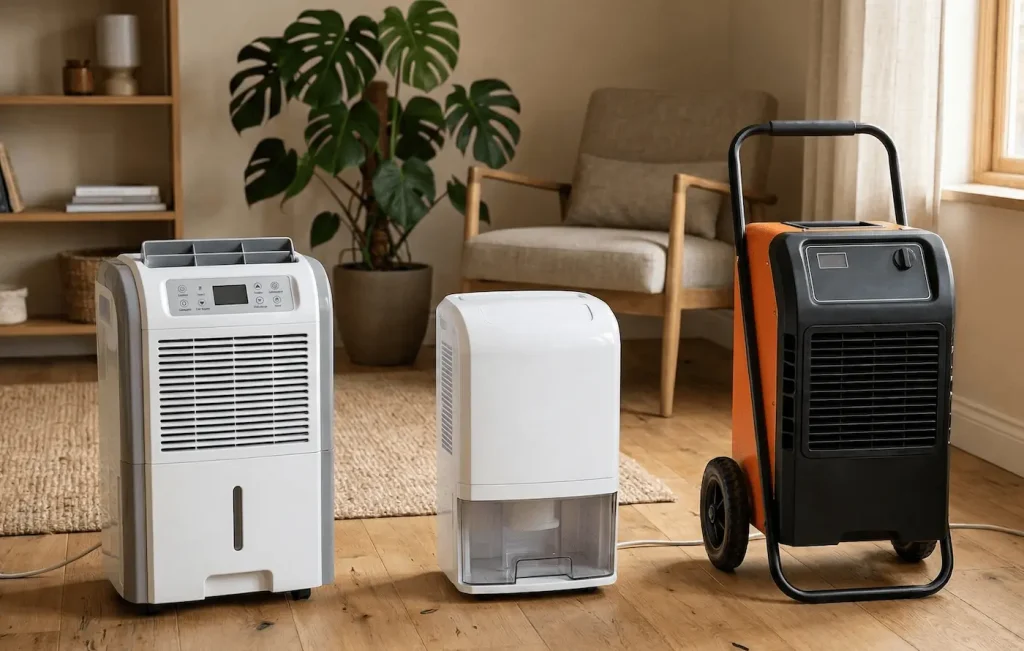
It’s incredibly easy to suffer from moisture damage when you can’t control your indoor climate.
Just a few weeks of high humidity, and your entire basement could be overrun by mold, or your warehouse inventory could be ruined by moisture, costing you thousands of dollars. It’s frustrating to spend money on a machine only to find out it stops working the moment the temperature drops.
We’ll help you solve your moisture problems. Here is a simple, practical guide to understanding the different types of dehumidifiers so you can protect your space effectively.
The Core Dehumidification Technologies Explained
To pick the right equipment, you first need to know how it actually pulls water out of the air. Let’s break down the three main technologies on the market today.
Compressor Dehumidifiers
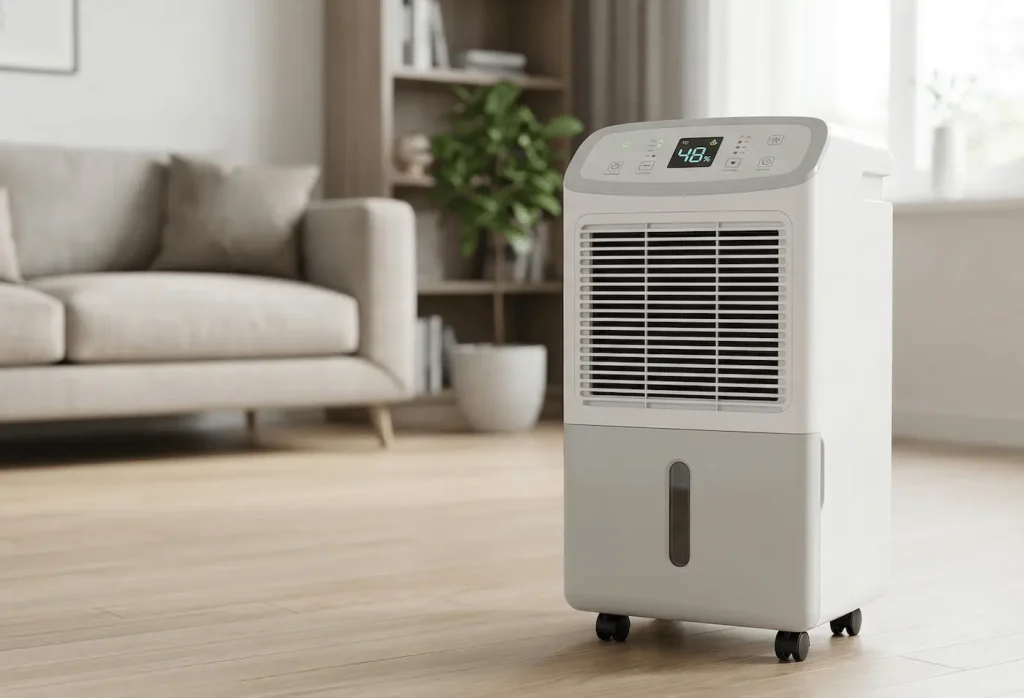
Compressor dehumidifiers are your go-to choice for warm, humid spaces like typical residential basements. They represent the vast majority of the market because they are cost-effective and highly efficient in the right conditions.
These units work just like your home air conditioner. A fan pulls damp air across a set of freezing cold coils. As the air hits the cold surface, the moisture condenses into liquid water and drips into a bucket or drain tube.
We recommend you use compressor units if your space stays above 65°F (18°C). In warmer temperatures, they draw very little power while extracting a massive amount of water.
However, physics limits their effectiveness in cold rooms. If your ambient temperature drops below 60°F (15°C), frost will start building up on the internal coils. The machine then has to pause its drying cycle to melt the ice, which drastically lowers how much water it can actually remove.
Desiccant Dehumidifiers
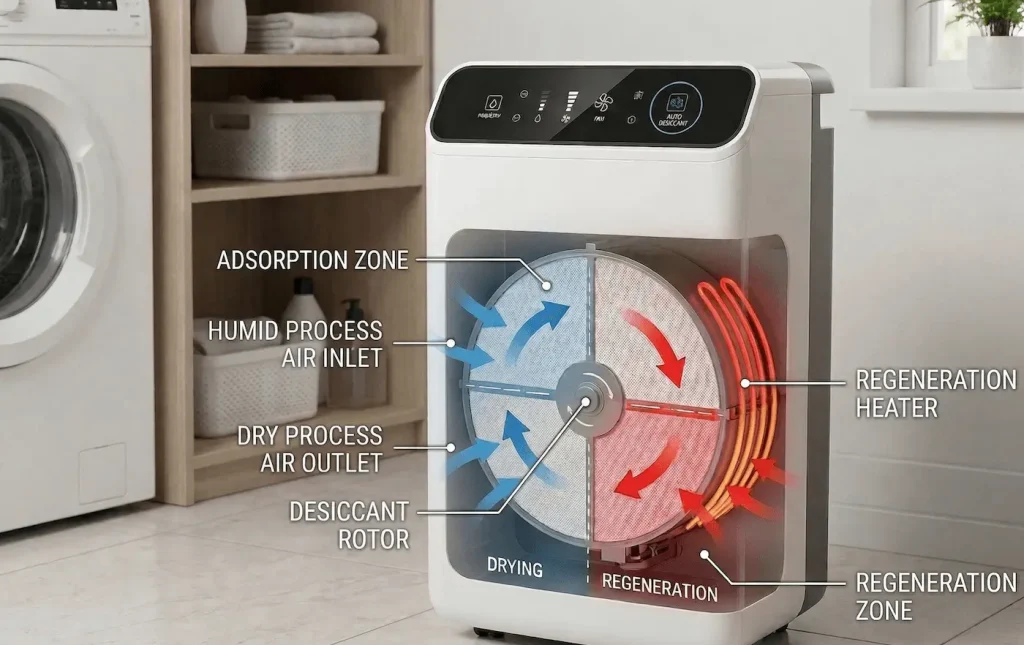
Desiccant units are the best option for freezing environments or industrial spaces that need to be bone-dry. They don’t rely on cold coils, so they maintain their full drying capacity even in sub-freezing temperatures.
Instead of cooling the air, these machines use a rotating wheel coated with a moisture-absorbing material, usually silica gel. As air passes through, the wheel traps the moisture. A built-in heater then bakes the moisture out of the wheel and vents it outside.
I’ve seen these units save unheated storage garages and winter construction sites from severe moisture delays. If you’re managing a pharmaceutical plant or protecting sensitive cargo, a desiccant system might be your safest bet.
The main trade-off here is energy consumption. Desiccants use an internal heater, so they draw more electricity per pint of water removed compared to standard compressors in warm weather.
Peltier Dehumidifiers
Peltier units only make sense for tiny, enclosed spaces like a single closet, a bathroom cabinet, or a gun safe.
They use an electrical current to create a hot side and a cold side on a small internal metal plate. A tiny fan draws air over the cold side to condense ambient moisture.
Because they have almost no moving parts, they are virtually silent. But they lack serious power. They usually only remove a few ounces of water a day. If you’re dealing with a flooded basement or a large room, this technology won’t help you at all.
Popular System Configurations
Beyond the core technology, how the unit is built and installed dictates where it works best.
Whole-House and Integrated HVAC Systems
If you want uniform humidity control across your entire home or office, an integrated system is the way to go. These treat the whole building at once rather than just a single room.
These units tie directly into your building’s existing ductwork. They pull air from the return duct, dry it out, and push it back into your main air supply.
They also offer superior energy efficiency. According to recent data from [External Link: Energy Star], installing a whole-house unit can often be more energy-efficient than running multiple portable units plugged into walls.
Just keep in mind that you’ll need a professional to install them. They require dedicated power circuits and hardwired integration with your thermostat.
In-Wall Dehumidifiers
In-wall units are great for rental properties, hotels, or finished basements where you want to save floor space.
They recess directly into the wall, fitting perfectly between standard 16-inch studs. Only a flat grille remains visible, which keeps your room looking clean and preserves your square footage.
They also route plumbing internally through your wall cavity. This means you never have to worry about manually emptying a heavy bucket of water again.
How to Size Your Dehumidifier
Proper sizing is critical. If your unit is too small, it will run constantly and burn its motor out. If it’s too large, it will turn on and off too fast, which we call “short-cycling.”
Understanding the Ratings
When comparing capacities, always look for the AHAM rating. This measures extraction at 80°F and 60% relative humidity, which perfectly mimics realistic, everyday conditions.
Be careful with “Saturation” ratings. Manufacturers often highlight these numbers (tested at 90°F and 90% humidity) because it makes the machine look much more powerful. Always check the AHAM rating so you’re comparing apples to apples.
Sizing for Your Application
If your living space just smells a bit musty, a 20 to 30-pint capacity unit might be enough for a 1,500 sq. ft. room. But if you see visible condensation on your walls, we recommend bumping up to a 50-pint capacity or higher.
For commercial warehousing, the math gets more complex. You have to calculate your air changes per hour (ACH). Large-scale desiccant dehumidifiers are frequently necessary to prevent metal corrosion in these massive environments.
If you’re buying a unit for commercial use, make sure it has an auto-restart feature. If the power goes out at your facility over the weekend, the unit will turn itself right back on, keeping your inventory safe while you’re away.
Final Thoughts: Which Dehumidifier is Right for You?
Choosing the right dehumidifier comes down to two crucial factors: your environment’s temperature and your target moisture level.
To recap:
- Go with a Compressor unit if you are dealing with a warm, humid environment (above 65°F) like a standard basement or indoor pool.
- Invest in a Desiccant system if you need to protect unheated spaces, winter construction sites, or industrial facilities where the temperature drops near freezing.
Now we’d like to hear from you.
Are you currently struggling to manage the humidity in your facility, or are you just looking for the right unit for a specific project? Contact us today, and we’ll help you size the perfect dehumidification system for your exact needs.